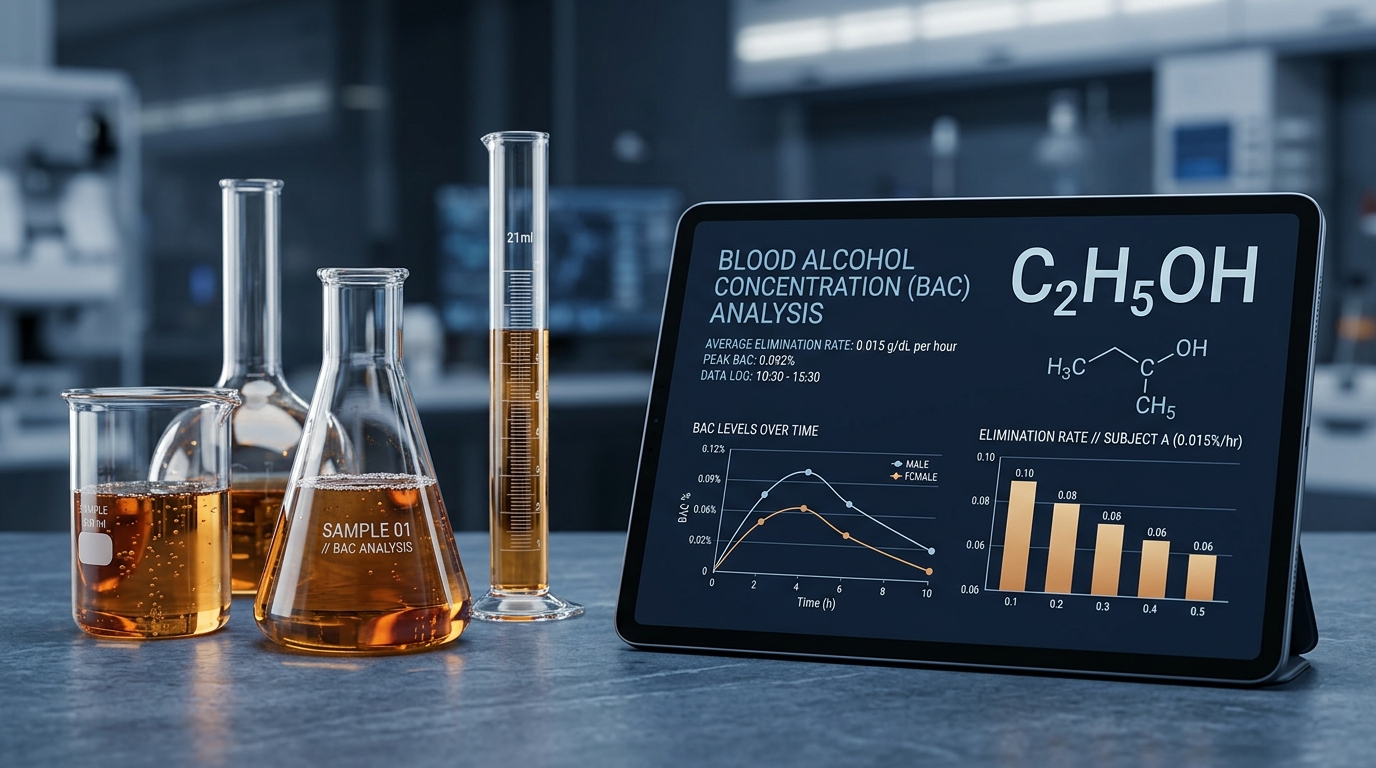
Understanding your body’s physiological response to alcohol is one of the most critical elements of personal safety, health literacy, and responsible decision-making. When individuals consume alcoholic beverages, ethanol molecules rapidly disperse through gastric membranes, enter the vascular system, and reach neural tissues within minutes.
Yet, despite widespread curiosity about alcohol clearance, few people understand the underlying mathematics or know how to calculate bac level with scientific rigor. Relying on casual guesswork or party folklore—such as assuming one drink per hour keeps everyone sober—routinely leads to dangerous errors.
Whether you are seeking clinical insight into ethanol kinetics or using an interactive blood alcohol concentration bac calculator, this guide details the exact formulas, biological variables, beverage equivalents, and reference charts required to demystify alcohol absorption and elimination.
What Does Blood Alcohol Concentration (BAC) Mean?
To grasp the mathematical modeling, one must first answer a fundamental pharmacological question: what does blood alcohol concentration (bac) mean in clinical terms?
Blood Alcohol Concentration (abbreviated as BAC) is a biochemical metric expressing the percentage of ethyl alcohol (ethanol) present in a person’s circulating bloodstream. Specifically, BAC measures the mass of ethanol in grams per 100 milliliters (or 1 deciliter) of whole blood.
- A BAC of 0.02% signifies 0.02 grams of alcohol per 100 mL of blood.
- A BAC of 0.08% (the statutory DUI threshold for motor vehicle operation in the United States and Canada) signifies 0.08 grams of alcohol per 100 mL of blood.
- A BAC of 0.20% reflects profound clinical intoxication, sensory suppression, and severe gross motor impairment.
Because ethanol possesses high water solubility and low lipid solubility, it distributes freely throughout the total volume of body water (TBW). Once absorbed through the stomach lining and small intestine, circulating ethanol directly interacts with gamma-aminobutyric acid (GABA) and N-methyl-D-aspartate (NMDA) neuroreceptors, slowing cerebral communications long before an individual perceives outward physical drunkenness.
The Core Mathematical Model: The Widmark Formula Explained
The foundation of modern forensic toxicology and online calculation stems from Swedish physician Erik M. P. Widmark, who established the standard pharmacokinetic model in 1932. When configuring an alcohol level blood calculator, software engines rely on refined adaptations of Widmark’s core equation:
BAC = [ (Alcohol Consumed in Grams / (Body Weight in Grams × r)) × 100 ] - (β × t)Where the key physiological variables include:
- Alcohol Consumed in Grams (A): The total mass of pure ethanol ingested.
- Body Weight (W): Body mass measured in grams (or converted from pounds: Weight in lbs × 453.592).
- Gender Distribution Ratio (r): The ratio of body water to total weight. By population average,
r = 0.68for biological males andr = 0.55for biological females (reflecting baseline adipose-to-lean muscle ratios). - Elimination Rate (β): The hourly metabolic clearance coefficient. Clinical population averages reflect
β ≈ 0.015%per hour (ranging between 0.012% and 0.020%). - Time elapsed (t): The duration in hours since alcohol intake commenced.
Practical Calculation Example:
Suppose an adult male weighing 180 lbs (81,647 g) consumes 3 standard drinks (42 g ethanol) over 2 hours:
1. Peak theoretical BAC = (42 / (81,647 × 0.68)) × 100 ≈ 0.0756%.
2. Elimination over 2 hours = 0.015% × 2 = 0.030%.
3. Estimated current BAC = 0.0756% - 0.030% ≈ 0.046%.
Calculating Across Different Beverages: Beer, Wine, and Distilled Spirits
A common challenge for consumers is standardizing intake across diverse drink styles. Serving sizes vary widely, making a dedicated blood alcohol content bac calculator beer wine & liquor invaluable.
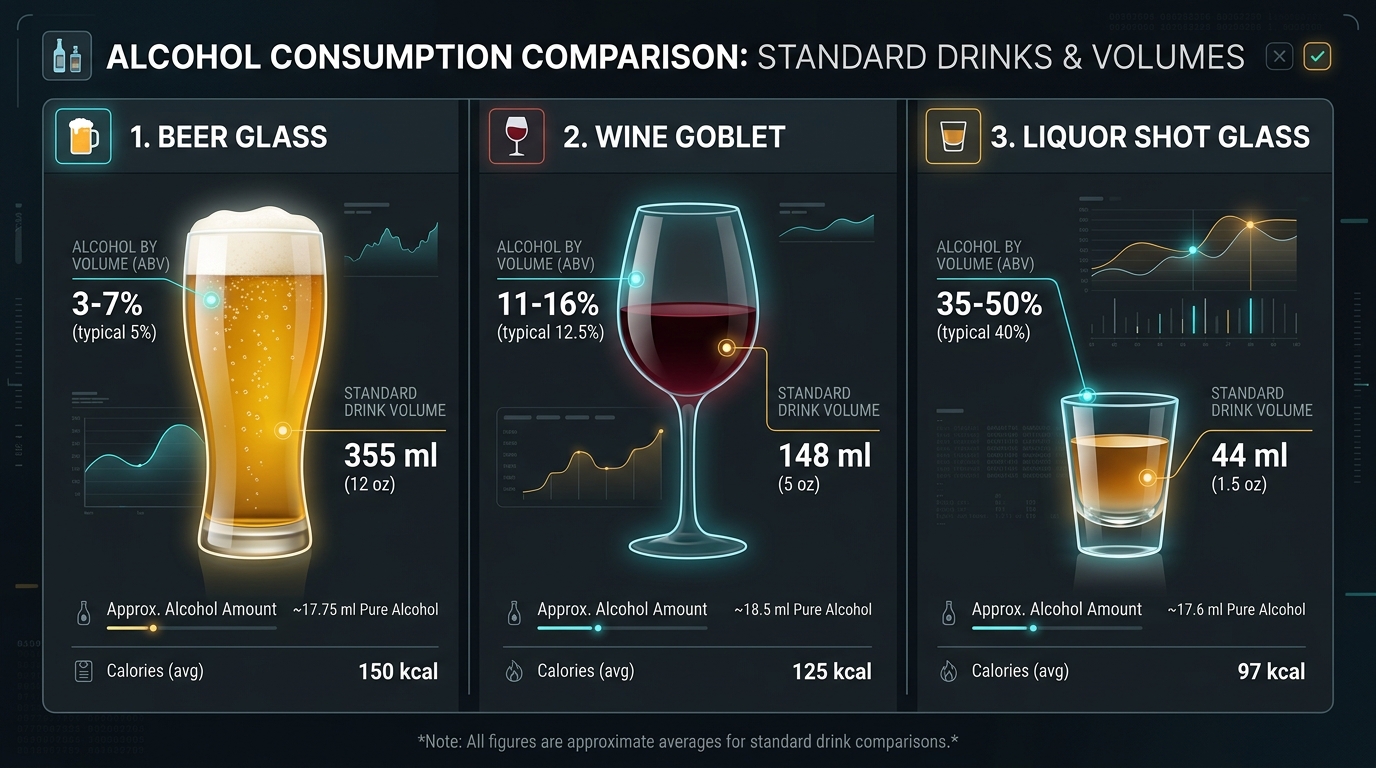
In the United States, the National Institute on Alcohol Abuse and Alcoholism (NIAAA) benchmarks one standard drink as containing exactly 14.0 grams (0.6 fluid ounces) of pure ethanol:
| Beverage Category | Serving Size | Average ABV (%) | Pure Ethanol | Standard Drinks |
|---|---|---|---|---|
| Domestic Light Beer | 12 fl oz (355 mL) | 4.2% – 5.0% | 14.0 g | 1.0 Unit |
| Craft Double IPA / Stout | 16 fl oz pint (473 mL) | 8.0% – 9.0% | 33.6 g – 40.3 g | 2.4 – 2.9 Units |
| Table Wine (Red / White) | 5 fl oz (148 mL) | 12.0% | 14.0 g | 1.0 Unit |
| Distilled Spirits (80 Proof) | 1.5 fl oz shot (44 mL) | 40.0% | 14.0 g | 1.0 Unit |
Converting Clinical Lab Values: Blood Ethanol Level to BAC Calculator Conversions
When reviewing emergency department toxicology reports or clinical pathology labs, results are frequently reported as serum or plasma ethanol in milligrams per deciliter (mg/dL) or millimoles per liter (mmol/L) rather than standard percent BAC.
Understanding a blood ethanol level to bac calculator conversion allows patients and researchers to translate hospital records accurately:
BAC (%) = Whole Blood Ethanol (mg/dL) / 1000
Whole Blood BAC (%) ≈ Serum Ethanol (mg/dL) / 1140
Because serum contains more water than whole red blood, serum values are approximately 10% to 18% higher than whole blood readings. For instance, a hospital serum reading of 80 mg/dL corresponds to approximately 0.070% whole blood BAC.
Blood Alcohol Concentration (BAC) Calculator Chart
Below is a reference blood alcohol concentration (bac) calculator chart illustrating estimated peak BAC based on biological sex, body weight, and standard drink units consumed within a single hour (prior to metabolic degradation):
| Weight | Sex | 1 Drink | 2 Drinks | 3 Drinks | 4 Drinks | 5 Drinks |
|---|---|---|---|---|---|---|
| 120 lbs (54 kg) | Female | 0.038% | 0.076% | 0.114% | 0.152% | 0.190% |
| Male | 0.031% | 0.062% | 0.092% | 0.123% | 0.154% | |
| 160 lbs (73 kg) | Female | 0.029% | 0.057% | 0.086% | 0.114% | 0.143% |
| Male | 0.023% | 0.046% | 0.069% | 0.092% | 0.115% | |
| 200 lbs (91 kg) | Female | 0.023% | 0.046% | 0.068% | 0.091% | 0.114% |
| Male | 0.018% | 0.037% | 0.055% | 0.074% | 0.092% |
Note: Subtract approximately 0.015% BAC for each hour elapsed since drinking commenced.
Critical Public Safety Reminder:
Under no circumstances should any mathematical BAC calculation be used to decide whether an individual is legal or physically safe to operate a motor vehicle. Sensory impairment, delayed hazard reaction, and tunnel vision begin at BAC levels as low as 0.02%. Always designate a sober driver or use rideshare services.
Frequently Asked Questions
Explore Interactive Tools & Resources:
- Interactive BAC Calculator Tool — Input weight, drinks, and timeline for customized range estimates.
- Alcohol Metabolism & Clearance Calculator — Model zero-order liver elimination decay curves.
- Blood Alcohol Concentration to Promille & German Driving Limits — Convert to European Promille units and review German traffic statutes.